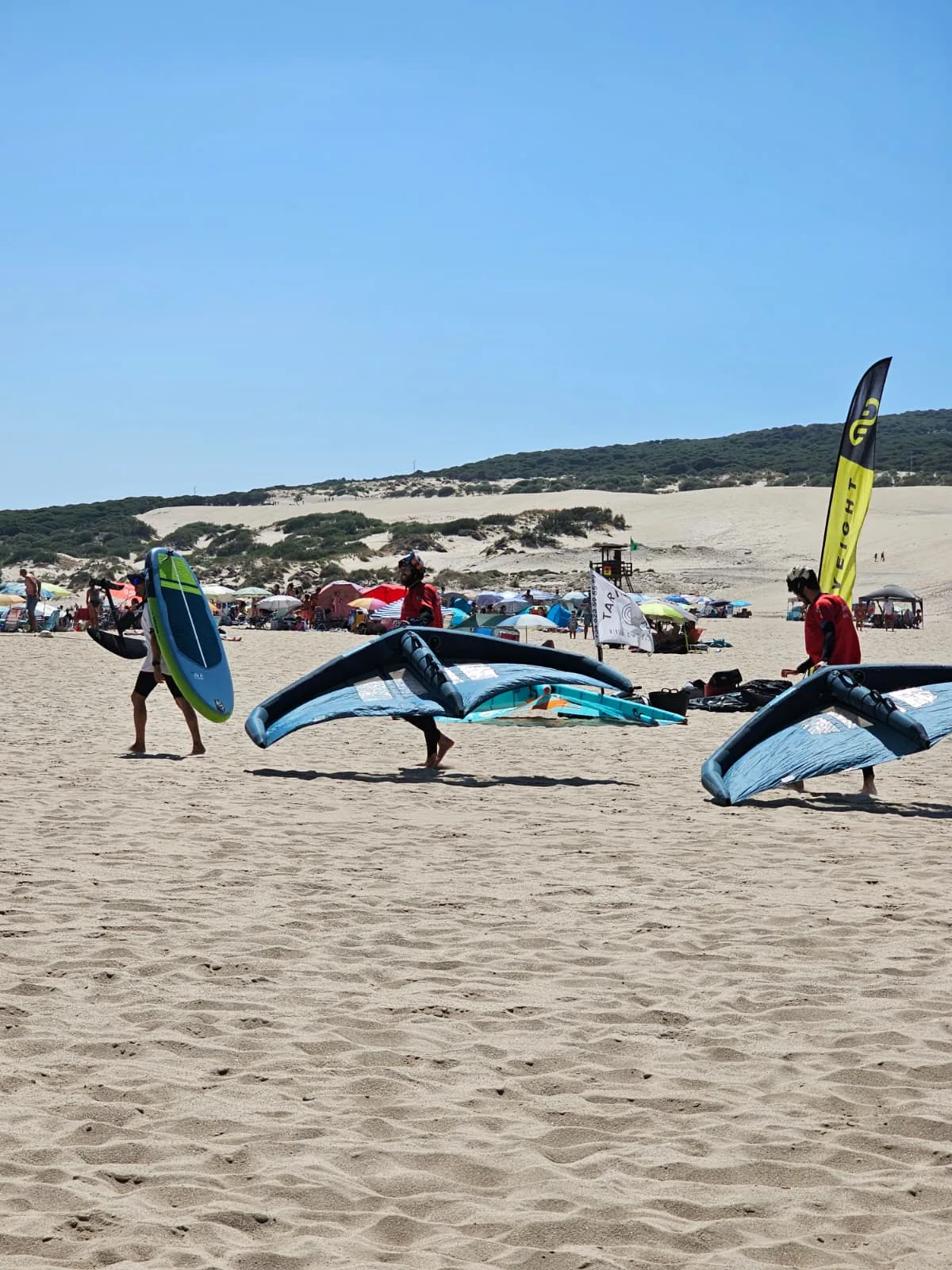
Tarifa doesn't have a single season: here kitesurfing happens 365 days a year. But there are months when the wind is more consistent, temperatures are more pleasant and the rider community gathers at the spots of the Strait with a special energy. In this article we explain the yearly wind cycle in Tarifa and the best time to come depending on your level and what you're looking for.
Levante and Poniente: the two engines of the Strait
The Strait of Gibraltar acts as a natural wind tunnel between the Atlantic and the Mediterranean. That explains why Tarifa has more windy days per year than almost any other town in Europe. The two main winds are the Levante and the Poniente, and they have very different characteristics.
The Levante
The Levante comes from the east, carrying the warmth of the Mediterranean. It's a thermal wind that usually picks up mid-morning and strengthens through the day. It can blow for three, four or even seven days straight without stopping, sometimes with gusts over 35 knots. The Levante kicks up a lot of chop (the white crests on the water), reduces visibility and can be hard to handle for less experienced riders, but advanced riders love it. With Levante, the water on Tarifa's Atlantic side is very choppy; on the Mediterranean side, somewhat flatter.
The Poniente
The Poniente comes from the Atlantic, is cooler and more humid, and is usually more manageable. Gusts are less violent, the water is more orderly and the wind range is more comfortable for learning. Many beginner students prefer the Poniente. The downside is that it's usually less consistent than the Levante and sometimes disappears in the afternoon.
The best time to learn
If it's your first time on the water with a kite, the easiest months are late spring (May-June) and autumn (September-October). Water temperatures are around 18-22°C, the wind is regular without being excessive and the beaches are less crowded than in summer, which gives more space on land during lessons.
In summer the wind can be very strong, especially with the Levante. It's fantastic for experienced riders but can be frustrating for beginners who don't yet have full control of the kite.
January and February: the best-kept secret
Winter in Tarifa is surprising for anyone coming from northern Spain or central Europe. Temperatures on land are around 15-18°C and the sun usually comes out after every storm. The water is colder (14-16°C), so a 4/3 wetsuit is necessary, but the wind is good and the beaches are almost empty. It's a completely different experience from summer: more intimate, rawer and, for many, more authentic.
Planning your trip: practical tips
- Book your lesson in advance if you're coming in July or August. In high season spots fill up fast.
- Bring clothes for different temperatures: mornings can be cool and midday hot, all on the same day.
- Check forecasts on Windguru or the AEMET app for the Strait, which has its own wind models. Tarifa's wind behaves in a specific way that generic forecasts don't always reflect well.
- If you can already ride, ask the school which spot to use depending on the day's wind. Río Palmones, Los Lances and Playa Chica have very different conditions.
- Remember there are currents off Tarifa. Never ride alone or without knowing the spot well.
The school is open all year
Kitesur has been in Tarifa since 2004 and we've never closed for the season. If there's wind and there are students, we teach. In winter groups are smaller and attention more personal. If you want to progress fast without the summer pressure, consider coming in January, February or March.